|
Home -
Gallery
Geology
Music
Software
Hiking
Links
Sport
What?
Thesis Paleontology Balkan Mineralogy Harz Steno 1 10 20 30 40 50 60 70 80 90 Anh A B C D E F 81 82 83 84 85 86 87 88 89 |
Page 140 of 401
< > |
                             - 87 -

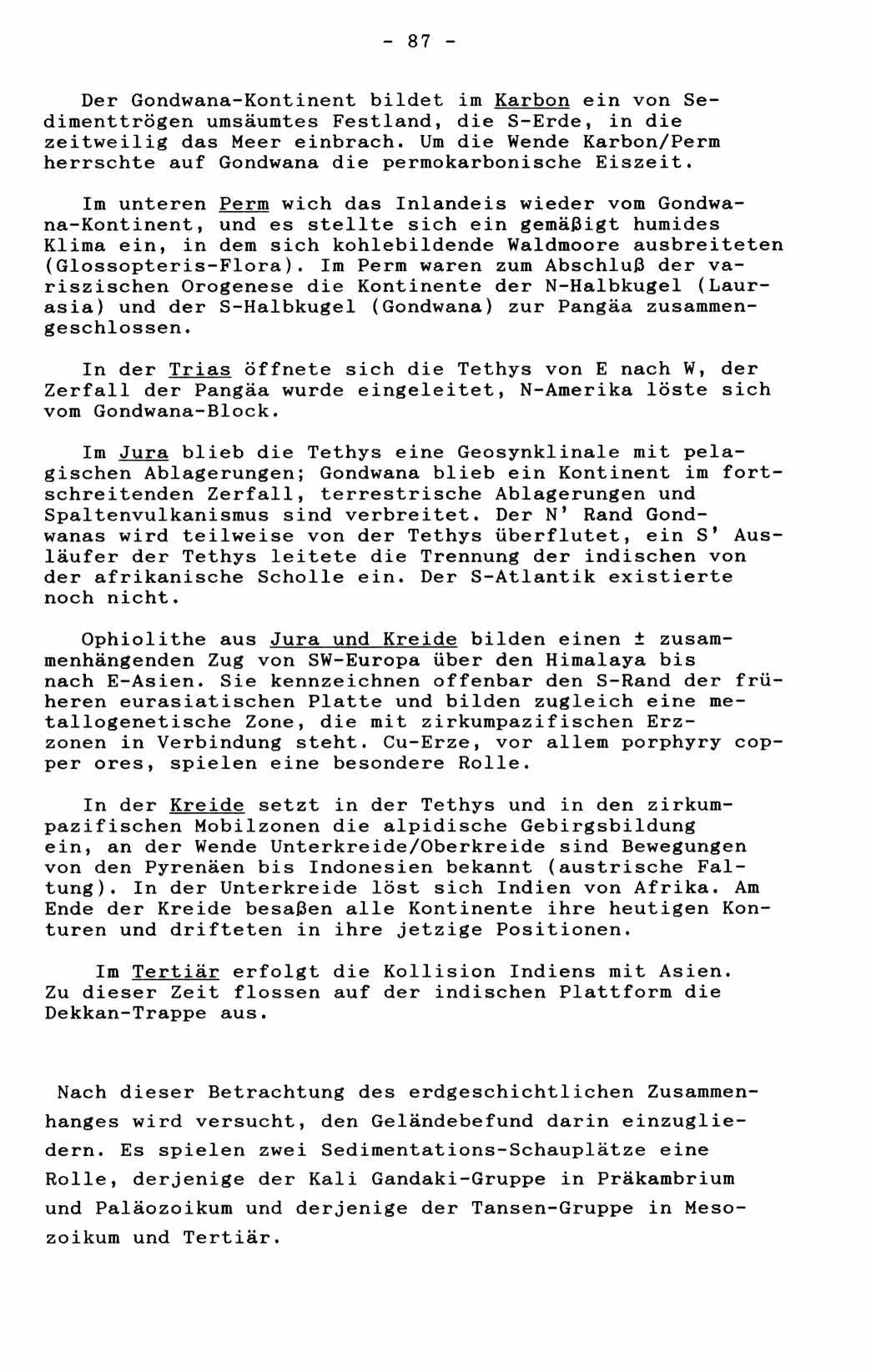
    Der Gondwana-Kontinent bildet im Karbon ein von Se-
 dimenttrögen umsäumtes Festland, die S-Erde, in die
 zeitweilig das Meer einbrach. Um die Wende Karbon/Perm
 herrschte auf Gondwana die permokarbonische Eiszeit.

    Im unteren Perm wich das Inlandeis wieder vom Gondwa-
 na-Kontinent, und es stellte sich ein gemäßigt humides
 Klima ein, in dem sich kohlebildende Waldmoore ausbreiteten
 (Glossopteris-Flora). Im Perm waren zum Abschluß der va-
 riszischen Orogenese die Kontinente der N-Halbkugel (Laur-
 asia) und der S-Halbkugel (Gondwana) zur Pangäa zusammen-
 geschlossen.

    In der Trias öffnete sich die Tethys von E nach W, der
 Zerfall der Pangäa wurde eingeleitet, N-Amerika löste sich
 vom Gondwana-Block.

    Im Jura blieb die Tethys eine Geosynklinale mit pela-
 gischen Ablagerungen; Gondwana blieb ein Kontinent im fort-
 schreitenden Zerfall, terrestrische Ablagerungen und
 Spaltenvulkanismus sind verbreitet. Der N' Rand Gond-
 wanas wird teilweise von der Tethys überflutet, ein S' Aus-
 läufer der Tethys leitete die Trennung der indischen von
 der afrikanische Scholle ein. Der S-Atlantik existierte
 noch nicht.

    Ophiolithe aus Jura und Kreide bilden einen ± zusam-
 menhängenden Zug von SW-Europa über den Himalaya bis
 nach E-Asien. Sie kennzeichnen offenbar den S-Rand der frü-
 heren eurasiatischen Platte und bilden zugleich eine me-
 tallogenetische Zone, die mit zirkumpazifischen Erz-
 zonen in Verbindung steht. Cu-Erze, vor allem porphyry cop-
 per ores, spielen eine besondere Rolle.

    In der Kreide setzt in der Tethys und in den zirkum-
 pazifischen Mobilzonen die alpidische Gebirgsbildung
 ein, an der Wende Unterkreide/Oberkreide sind Bewegungen
 von den Pyrenäen bis Indonesien bekannt (austrische Fal-
 tung). In der Unterkreide löst sich Indien von Afrika. Am
 Ende der Kreide besaßen alle Kontinente ihre heutigen Kon-
 turen und drifteten in ihre jetzige Positionen.

    Im Tertiär erfolgt die Kollision Indiens mit Asien.
 Zu dieser Zeit flossen auf der indischen Plattform die
 Dekkan-Trappe aus.


  Nach dieser Betrachtung des erdgeschichtlichen Zusammen-
 hanges wird versucht, den Geländebefund darin einzuglie-
 dern. Es spielen zwei Sedimentations-Schauplätze eine
 Rolle, derjenige der Kali_Gandaki-Gruppe in Präkambrium
 und Paläozoikum und derjenige der Tansen-Gruppe in Meso-
 zoikum und Tertiär.
                             - 87 -

  In the Carboniferous the Gondwana continent, the South
 Earth is a land, which is wmbraced by sediment_basins and in
 which sometimes the ocean came in. At the changing from
 Carboniferous to Permian existed on Gondwana the
 Permocarbonian Ice Ages.

    During the lower Permian retreated the ice from the
 Gondwana comtinent and a moderate humide climate developed,
 in which grew Carboniferous forest bogs (Glossopteris flora).
 During the Permian at the finishing of the Variscan orogeny
 the continents of the northern hemisphere ("Laurentia") and
 of the southern hemisphere (Gondwana) were merged to the
 Pangaea.

    During the Trias opened the Tethys from E to W, the decay
 of Pangaea was induced, North America was separated from the
 Gondwana block.

    During the Jurassic the Tethys remained a geosynkline with
 pelagic sedimentation; Gondwana stayed as a continent with
 increasing decay, terrestric sediments and twodimensional
 volcanism ("Spaltenvulkanismus") are spread. The northern
 edge of Gondwana is during some times floodet by the Tethys,
 a south-extension of the Tethys separates the African and the
 Indian plate. The South Atlantic does not yet exist.

    Ophilithes of Jurassic and Cretaceous form a ± continuous
 belt from S-Europe over the Himalayas to E-Asia. They
 obviously mark the S-edge of the former Eurasian plate, and
 they make a matallogenetic zone, which is in connection with
 the circumpazific ore-zones. Copper-ores, mainly porphyry
 copper ores play a special role.

    During the Cretaceous in the circumpacific mobilization
 zones startet the Alpidic orogenesis. At the changing Lower
 Cretaceous / Upper Cretaceous movements from the Pyrenaes
 to Indonesia are known ("Austrische" phase). During the
 Lower Cretaceous India scaled off from Africa. During the
 Cretaceous all continents owed their recent contours and
 drifted to their recent position.

    At the changing Cretaceous/Tertiary the collision of India
 with Asia took place. During this time on the Indian platform
 the Dekkan Trappes pour out.

    After this view of the geological interdependencies it
 will be tried to put the field_findings into it. Two
 sedimentation places play a roll, the one of the Kali Gandaki
 Supergroup during Precambrian and Palaeozoic and the one of
 the Tansen Group during Mesozoic and Tertiary.
|
.