|
Home -
Gallery
Geology
Music
Software
Hiking
Links
Sport
What?
Thesis Paleontology Balkan Mineralogy Harz Steno 1 10 20 30 40 50 60 70 80 90 Anh A B C D E F 81 82 83 84 85 86 87 88 89 |
Page 139 of 401
< > |
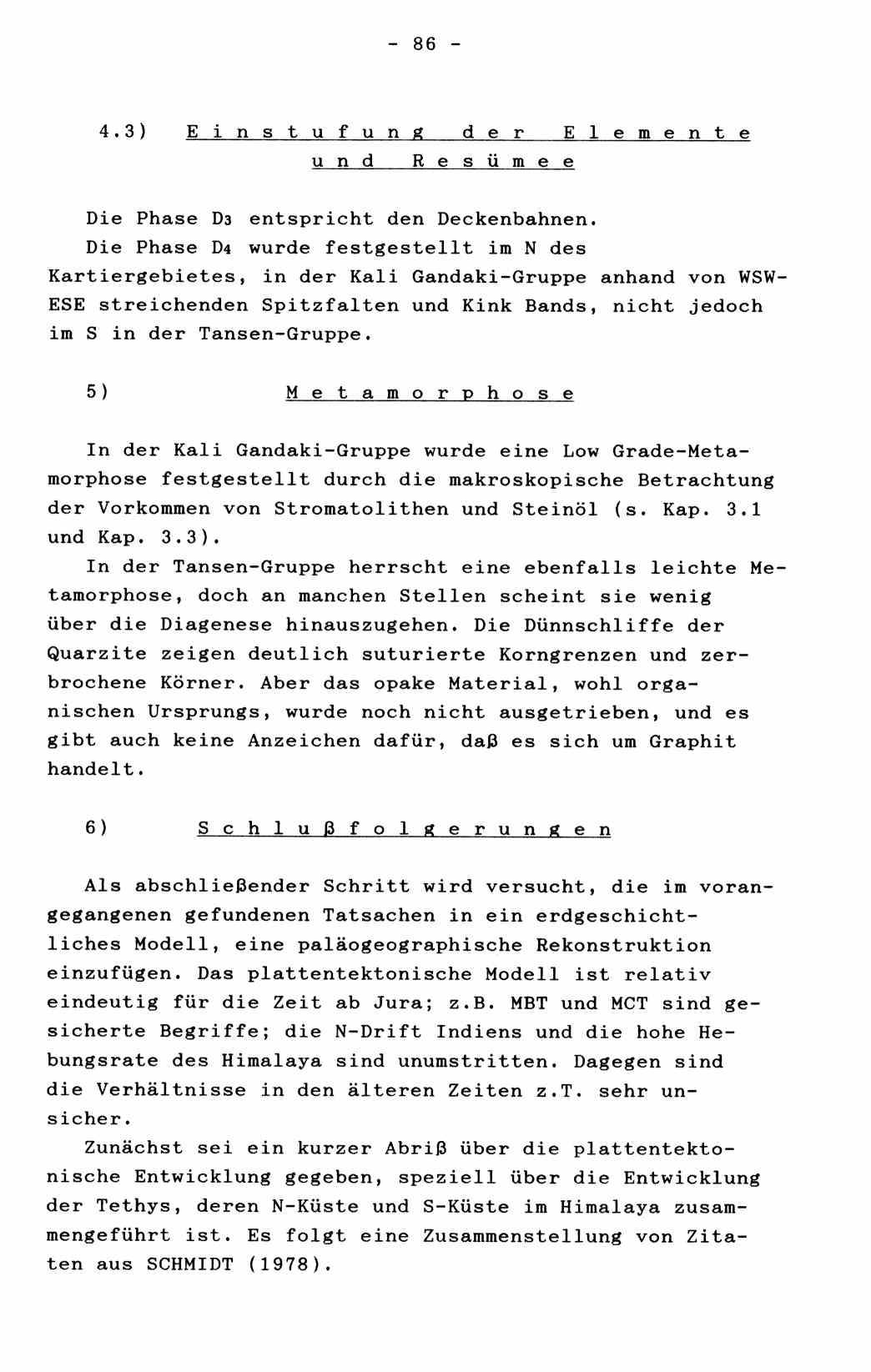
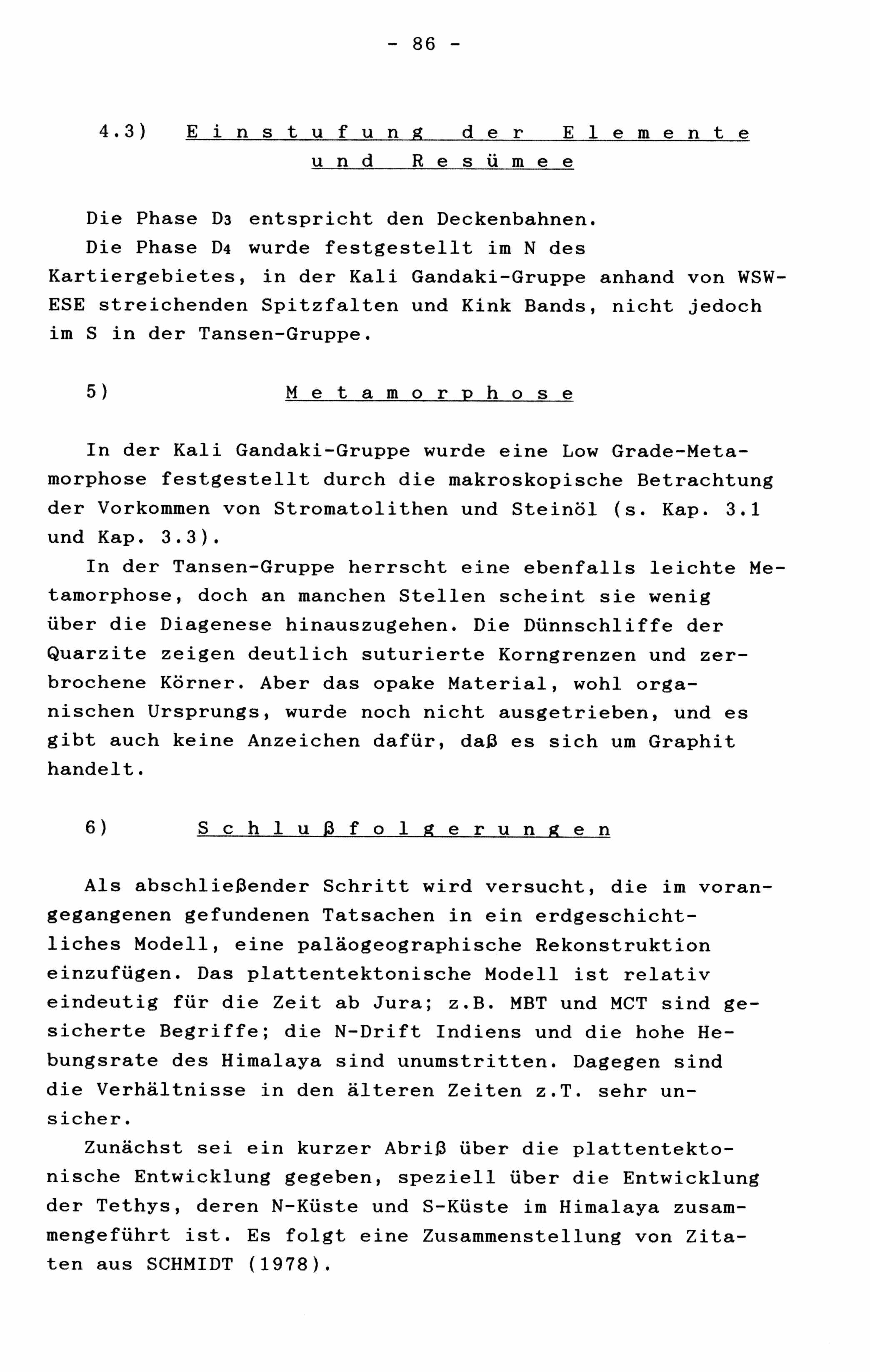
                             - 86 -


     4.3)   E i n s t u f u n g   d e r   E l e m e n t e
                      u n d   R e s ü m e e

    Die Phase D3 entspricht den Deckenbahnen.
    Die Phase D4 wurde festgestellt im N des
 Kartiergebietes, in der Kali Gandaki-Gruppe anhand von WSW-
 ESE streichenden Spitzfalten und Kink Bands, nicht jedoch
 im S in der Tansen-Gruppe.

    5)              M e t a m o r p h o s e

    In der Kali Gandaki-Gruppe wurde eine Low Grade-Meta-
 morphose festgestellt durch die makroskopische Betrachtung
 der Vorkommen von Stromatolithen und Steinöl (s. Kap. 3.1
 und Kap. 3.3).
    In der Tansen-Gruppe herrscht eine ebenfalls leichte Me-
 tamorphose, doch an manchen Stellen scheint sie wenig
 über die Diagenese hinauszugehen. Die Dünnschliffe der
 Quarzite zeigen deutlich suturierte Korngrenzen und zer-
 brochene Körner. Aber das opake Material, wohl orga-
 nischen Ursprungs, wurde noch nicht ausgetrieben, und es
 gibt auch keine Anzeichen dafür, daß es sich um Graphit
 handelt.

    6)       S c h l u ß f o l g e r u n g e n

    Als abschließender Schritt wird versucht, die im voran-
 gegangenen gefundenen Tatsachen in ein erdgeschicht-
 liches Modell, eine paläogeographische Rekonstruktion
 einzufügen. Das plattentektonische Modell ist relativ
 eindeutig für die Zeit ab Jura; z.B. MBT und MCT sind ge-
 sicherte Begriffe; die N-Drift Indiens und die hohe He-
 bungsrate des Himalaya sind unumstritten. Dagegen sind
 die Verhältnisse in den älteren Zeiten z.T. sehr un-
 sicher.
    Zunächst sei ein kurzer Abriß über die plattentekto-
 nische Entwicklung gegeben, speziell über die Entwicklung
 der Tethys, deren N-Küste und S-Küste im Himalaya zusam-
 mengeführt ist. Es folgt eine Zusammenstellung von Zita-
 ten aus SCHMIDT (1978).
                             - 86 -


    4.3)     C l a s s i f i c a t i o n   o f   t h e
               e l e m e n t s   a n d   r e s u m e

    The phase D3 is represented i the thrust planes.
    The phase D4 was found in the north of the mapping area,
 in the Kali Gandaki Supergroup, by the appearence of WSW-ENE
 striking sharp folds and kink bands; it was not found in the
 south, in the Tansen Group.

    5)               M e t a m o r p h o s i s

    In the Kali Gandaki Supergroup a Low Grade Metamorphosis
 was pointed out by macroscopic observations of the
 appearences of stromatolithes and "rock juice" (see chapter
 3.1 and 3.3).
    In the Tansen Group exists also a low grade metamorphosis,
 but at some places it seems hardly to exceed the diagenesis.
 The thinn_sections of the quarzites show clearly sutured
 grain boundaries and broken grains. But the opaque material,
 probably of organic origin, is not yet expeled, and there are
 no indications that it is graphite.

    6)                 C o n c l u s i o n s

    As final step it is attempted, to put the found facts into
 an geologic model, into a paleogeographic reconstruction. The
 plate tectonic model is relative clear in the time from
 Jurassic to the present; e.g. MBT and MCT are certain ideas;
 the north drift of India and the high uplift-rate of the
 himalayas are not controversial. But the constellations in
 the older times are to some degree very uncertain.
    First a short abstract about the plate tectonic
 development may be given, especially about the development of
 the Tethys, whose north and south coast came close together
 in the Himalayas. The following text is a summary with
 quotations of SCHMIDT (1978).
|
.