|
Home -
Gallery
Geology
Music
Software
Hiking
Links
Sport
What?
Thesis Paleontology Balkan Mineralogy Harz Steno 1 10 20 30 40 50 60 70 80 90 Anh A B C D E F 21 22 23 24 25 26 27 28 29 |
Page 82 of 401
< > |
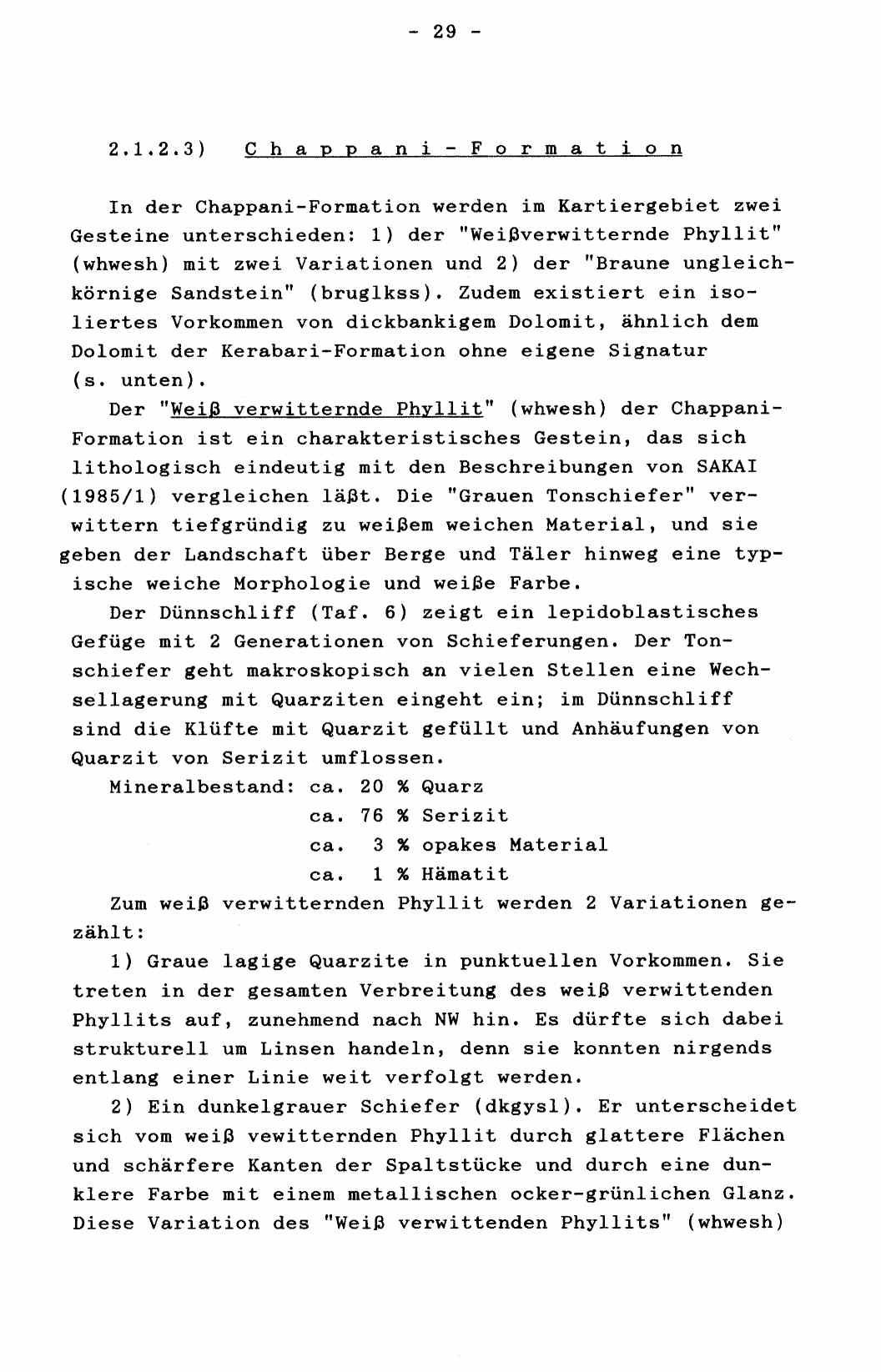
                             - 29 -


    2.1.2.3)   C h a p p a n i - F o r m a t i o n

    In der Chappani-Formation werden im Kartiergebiet zwei
 Gesteine unterschieden: 1) der "Weißverwitternde Phyllit"
 (whwesh) mit zwei Variationen und 2) der "Braune ungleich-
 körnige Sandstein" (bruglkss). Zudem existiert ein iso-
 liertes Vorkommen von dickbankigem Dolomit, ähnlich dem
 Dolomit der Kerabari-Formation ohne eigene Signatur
 (s. unten).
    Der "Weiß verwitternde Phyllit" (whwesh) der Chappani-
 Formation ist ein charakteristisches Gestein, das sich
 lithologisch eindeutig mit den Beschreibungen von SAKAI
 (1985/1) vergleichen läßt. Die "Grauen Tonschiefer" ver-
 wittern tiefgründig zu weißem weichen Material, und sie
 geben der Landschaft über Berge und Täler hinweg eine typ-
 ische weiche Morphologie und weiße Farbe.
    Der Dünnschliff (Taf. 6) zeigt ein lepidoblastisches
 Gefüge mit 2 Generationen von Schieferungen. Der Ton-
 schiefer geht makroskopisch an vielen Stellen eine Wech-
 sellagerung mit Quarziten eingeht ein; im Dünnschliff
 sind die Klüfte mit Quarzit gefüllt und Anhäufungen von
 Quarzit von Serizit umflossen.
    Mineralbestand: ca. 20 % Quarz
                    ca. 76 % Serizit
                    ca.  3 % opakes Material
                    ca.  1 % Hämatit
    Zum weiß verwitternden Phyllit werden 2 Variationen ge-
 zählt:
    1) Graue lagige Quarzite in punktuellen Vorkommen. Sie
 treten in der gesamten Verbreitung des weiß verwittenden
 Phyllits auf, zunehmend nach NW hin. Es dürfte sich dabei
 strukturell um Linsen handeln, denn sie konnten nirgends
 entlang einer Linie weit verfolgt werden.
    2) Ein dunkelgrauer Schiefer (dkgysl). Er unterscheidet
 sich vom weiß vewitternden Phyllit durch glattere Flächen
 und schärfere Kanten der Spaltstücke und durch eine dun-
 klere Farbe mit einem metallischen ocker-grünlichen Glanz.
 Diese Variation des "Weiß verwittenden Phyllits" (whwesh)
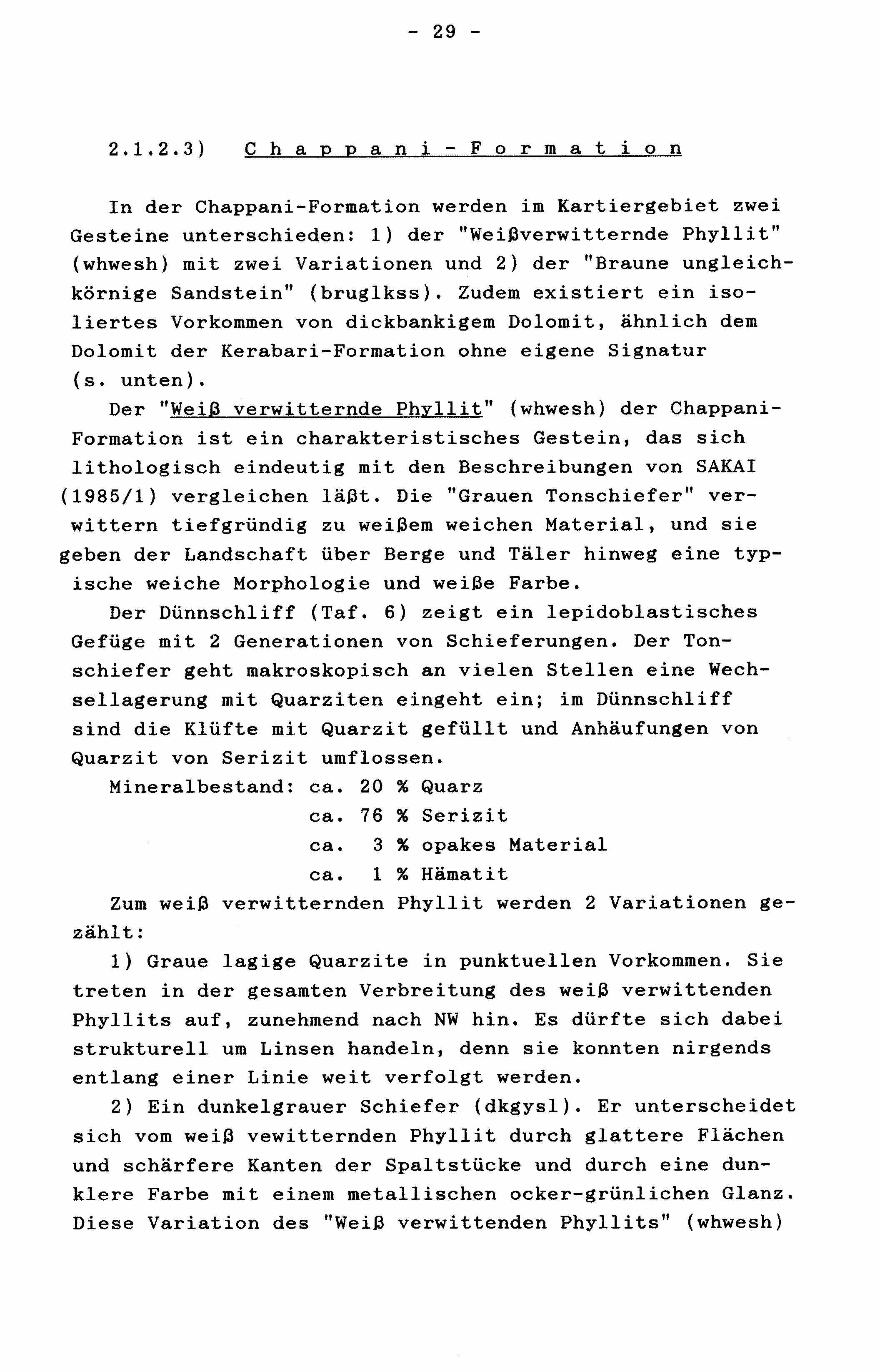
                             - 29 -


    2.1.2.3)      C h a p p a n i   F o r m a t i o n

    In the Chappani Formation are two types of rocks
 distinguished in the mapping area: 1) the "White Weathering
 Phyllite" (whwesh) with two variations and 2) the "Brown
 Inequigranular Sandstone" (bruglkss). Besides this exists an
 isolated occurrece of thick banked dolomite, similar to the
 dolomite of the Kerabari Formation, without signature (see
 below).
    The "White Weathering Phyllite" (whwesh) of the Chappani
 Formation is a charakteristic rock type, which is
 lithostratigraphically obviously comparable with the
 descriptions of SAKAI (1985/1). This "Gray Shale" weatheres
 deeply to a white, soft material, and it bestows on the
 landscape a typical soft morphology and white color over the
 hills and valleys.
    The thin section (plate 6) shows a lepidoblastic texture
 with two generations of shistosity. As macroscopically the
 shale intercalates with white quarzites at many places, are
 in the thin section the cleaves filled with quarz and
 accumulations of quarz are floated around by serizite.
    The mineral composition: ± 20 % quarz
                             ± 76 % serizite
                             ±  3 % opaque material
                             ±  1 % hematite.
    The "White Weathering Phyllite" includes two variations:
    1) Grey layered quarzites in punctual occurrences. They
 appeare in the whole area of the "White Wheathering Phyl-
 lite", increasing to the NW. Structurally it might be a
 matter of lenses or wedges, because they could nowhere be
 traced over a longer distance.
    2) A dark grey slate (dkgysl). It differes from the "White
 Weathering Phyllite" by smoother surfaces and sharper edges
 of the splitted pieces and by a darker color with metallic
 ocre-green shining. This variation of the "White Weathering
 Phyllite" occures in the
|
.