|
Home -
Gallery
Geology
Music
Software
Hiking
Links
Sport
What?
Thesis Paleontology Balkan Mineralogy Harz Steno 1 10 20 30 40 50 60 70 80 90 Anh A B C D E F 21 22 23 24 25 26 27 28 29 |
Page 75 of 401
< > |
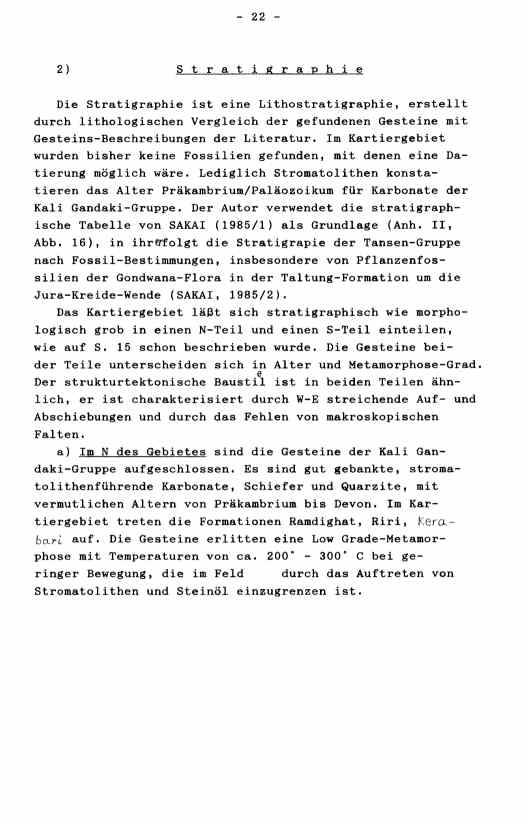
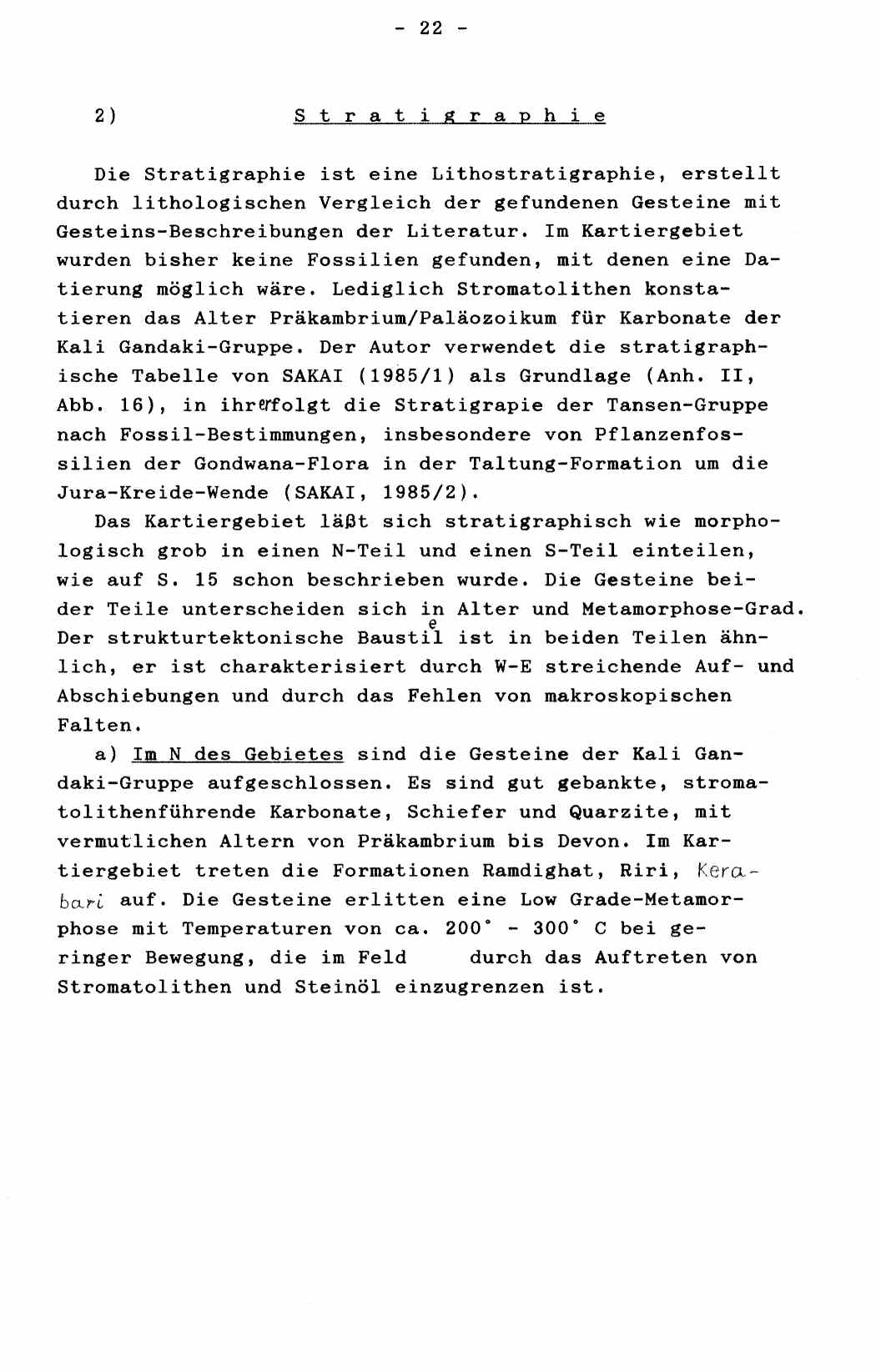
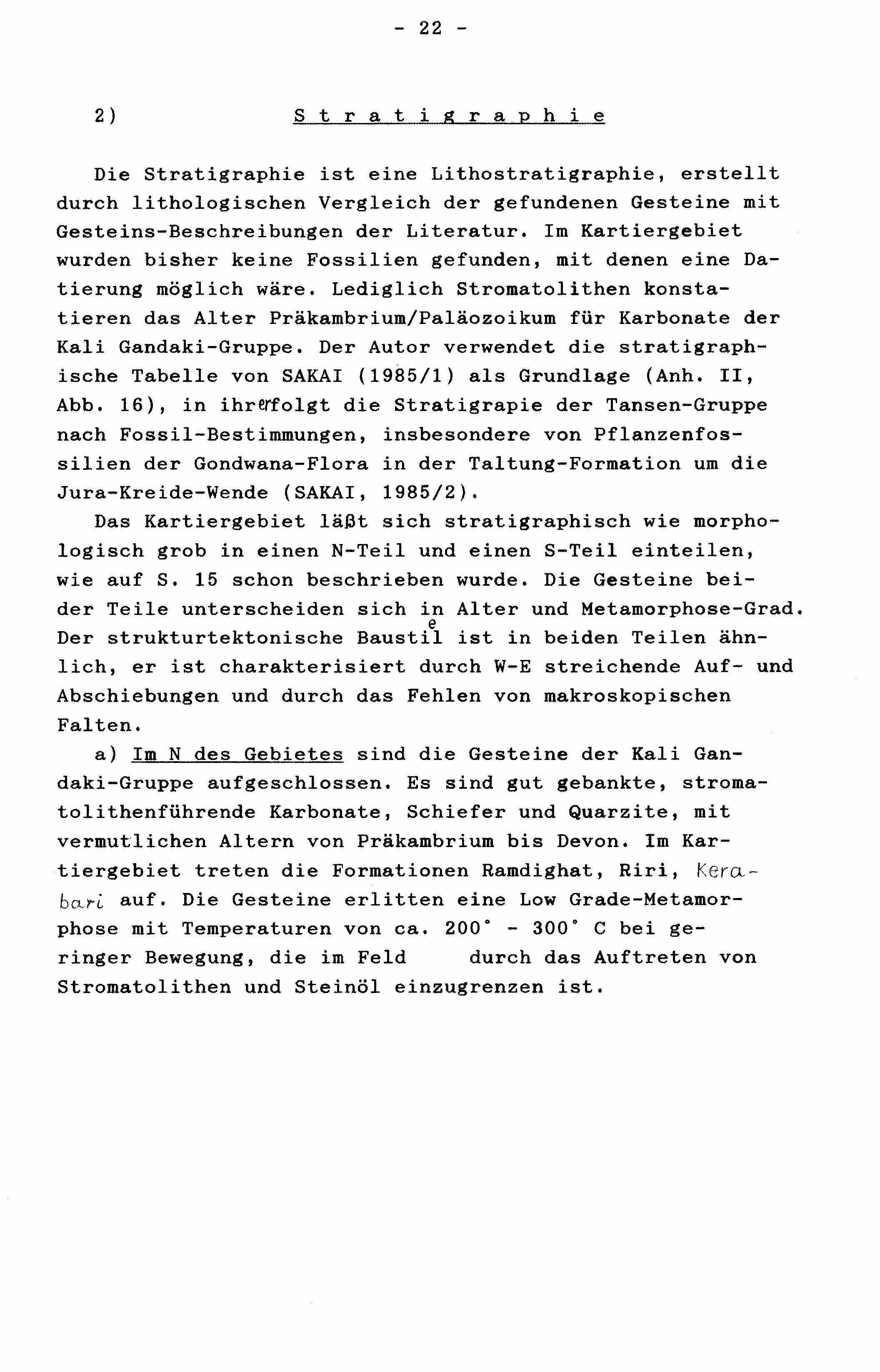
                             - 22 -


    2)              S t r a t i g r a p h i e

    Die Stratigraphie ist eine Lithostratigraphie, erstellt
 durch lithologischen Vergleich der gefundenen Gesteine mit
 Gesteins-Beschreibungen der Literatur. Im Kartiergebiet
 wurden bisher keine Fossilien gefunden, mit denen eine Da-
 tierung möglich wäre. Lediglich Stromatolithen konsta-
 tieren das Alter Präkambrium/Paläozoikum für Karbonate der
 Kali Gandaki-Gruppe. Der Autor verwendet die strati-
 graphische Tabelle von SAKAI (1985/1) als Grundlage
 (Anh. II, Abb. 16), in ihr erfolgt die Stratigrapie der
 Tansen-Gruppe nach Fossil-Bestimmungen, insbesondere von
 Pflanzenfossilien der Gondwana-Flora in der Taltung-For-
 mation um die Jura-Kreide-Wende (SAKAI, 1985/2).
    Das Kartiergebiet läßt sich stratigraphisch wie morpho-
 logisch grob in einen N-Teil und einen S-Teil einteilen,
 wie auf S. 15 schon beschrieben wurde. Die Gesteine bei-
 der Teile unterscheiden sich in Alter und Metamorphose-Grad.
 Der strukturtektonische Baustil ist in beiden Teilen ähn-
 lich, er ist charakterisiert durch W-E streichende Auf- und
 Abschiebungen und durch das Fehlen von makroskopischen
 Falten.
    a) Im N des Gebietes sind die Gesteine der Kali Gan-
 daki-Gruppe aufgeschlossen. Es sind gut gebankte, stroma-
 tolithenführende Karbonate, Schiefer und Quarzite, mit
 vermutlichen Altern von Präkambrium bis Devon. Im Kar-
 tiergebiet treten die Formationen Ramdighat, Riri, Kera-
 bari auf. Die Gesteine erlitten eine Low Grade-Metamor-
 phose mit Temperaturen von ca. 200° - 300° C bei gerin-
 ger Bewegung, die im Feld durch das Auftreten von Stroma-
 tolithen und Steinöl einzugrenzen ist.
                             - 22 -


    2)           S t r a t i g r a p h y

    The stratigraphy is a lithostratigraphy, put up by
 lithological comparison of the found rocks with rock-
 descriptions in the literature. In the mapping area until now
 no fossils are found, by which the dating would be possible.
 Only stromatolithes demonstrate the age from the Paleozoic to
 the old Mesozoic for the carbonates of the Kali Gandaki
 Supergroup. The autor uses the stratigraphic table of SAKAI
 (1985/1) (see fig. II-16), in which the stratigraphy of the
 Tansen Group results from fossil determinations, especially
 of plant fossils of the Gondwana flora in the Taltung
 Formation near the Jurassic/Cretaceous-boundary (SAKAI,
 1985/2).
    The mapping area is stratigraphically and morphologically
 roughly to divide in a northern part and a southern part, as
 described on page 15. The rocks of the two parts are
 different in their age and their degree of metamorphosis. The
 stuctur-tectonic architecture is similar in both parts, it is
 charaktarised by W-E-striking normal and inverse faults and
 by the absens of mesoscopic folds.
    a) In the N of the area the older rocks, those of the
 Kali Gandaki Supergroup are exposed. They are well banked,
 stromatolithe bearing carbonates, shists and quarzites with
 suspected ages of Praecambrian to Devonian. In the mapping
 area appeare the formations Ramdighat, Riri and Kerabari. The
 rock suffered a low grade metamorphosis with temperatures
 from about 200° - 300° C with low dynamics, proofed
 macroscopically by the appearance of stromatolithes and rock
 juice.
|
.